Core Concepts: Course 2
Core Concepts: Source Code
Melody by Numbers. The Major Scale, Unlocked.
Learn to play the same melody in five different keys, all within the first four frets of your guitar.
Instead of memorising five separate scale patterns, you'll learn how the major scale works through a simple system of numbers.
Start in C major. Change just one note to reach G major. One more takes you to D, then A, then E.
Along the way, you'll learn to hear the notes, understand their relationships, and use your scale knowledge to play real music.
One melody. Five keys. A method you'll use for the rest of your playing.

Launch Week Bundle
New to Core Concepts?
Get Fretboard GPS, Source Code and the Circle of Fifths guide together for $99 during Black Friday week.
(Save $41. Click the image below)
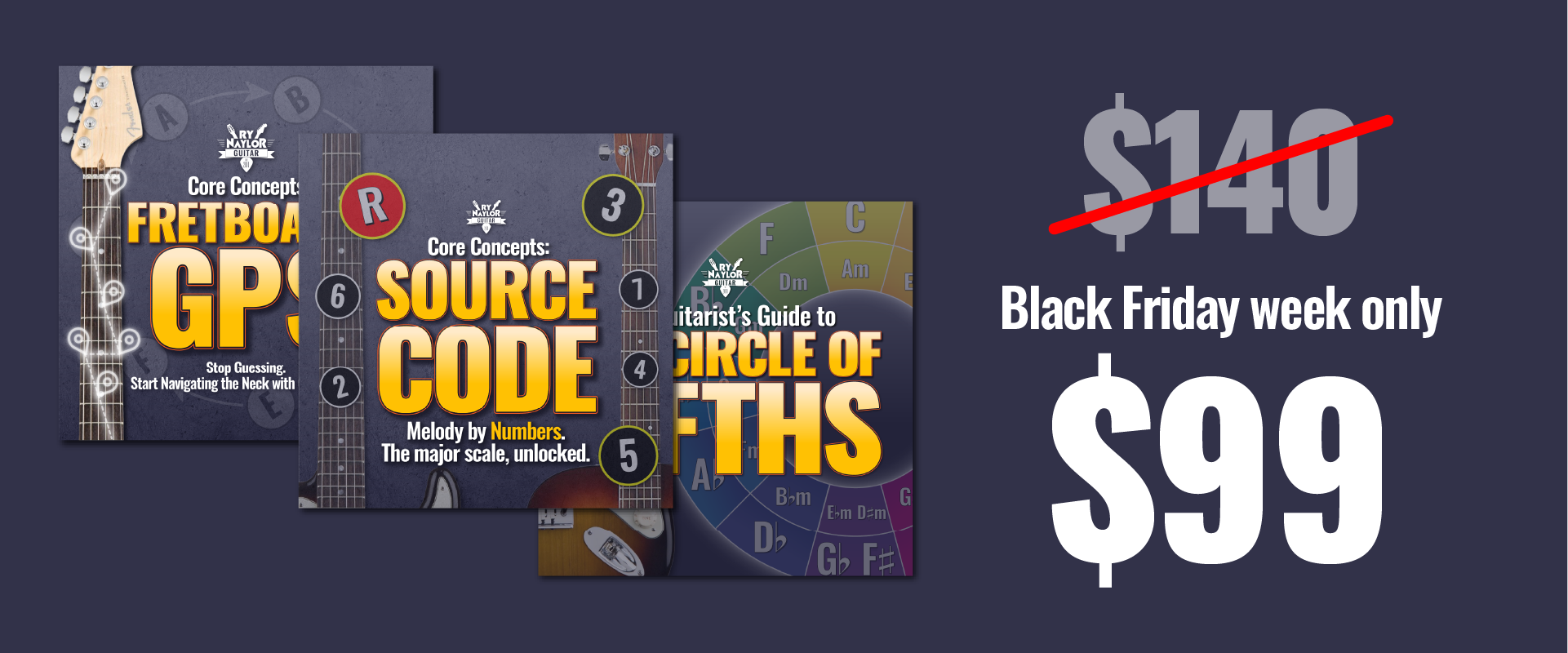
Exclusively for Black Friday week

The Problem
You know the shapes. But do you know the music inside them?
Guitarists learn scales as patterns. You practise the shapes, move them around the neck, and gradually become more comfortable with where your fingers should go.
But knowing where to put your fingers isn't quite the same as understanding what you're playing.
Can you identify the notes within a scale? Do you know why some sound settled while others want to move? Could you take a familiar melody and play it in a different key without starting from scratch?
These are the connections that often get missed.
And the answer isn't necessarily learning more shapes. It's understanding the ones you already know.
That's where Source Code comes in.
The Method
One melody. Five keys. One simple idea.
At the heart of Source Code is a different way of thinking about music.
Instead of learning melodies as a sequence of note names or fret numbers, you'll learn to understand them as scale degrees, numbers that describe each note's relationship to the Root.
These relationships stay the same regardless of the key.
Learn a melody in C major and you'll understand how to play that same melody in G, D, A and E major.
And here's the clever part.
We move through these five keys in a deliberate order. Each new scale differs from the previous one by just a single note.
C becomes G. G becomes D. D becomes A. A becomes E.
One note changes at a time.
You'll see how the scales are constructed, hear how the notes relate to one another, and gradually discover the logic connecting them all.
You're not learning five unrelated scales. You're learning one system
“I wish that I had started my guitar journey with Source Code.
It uses the open position as a foundation to understand the notes and scale degrees in all the basic keys and how music actually works."

Why the open position?
The foundation, not the beginner zone
The first four frets are often treated as beginner territory, somewhere to move beyond as quickly as possible.
But there's an enormous amount of music and theory to discover here.
The open position contains the notes of every major scale, and the five familiar open-position keys give us an excellent starting point for understanding how the guitar works.
By concentrating on this small area of the fretboard, we can remove unnecessary complexity and focus on the relationships between notes.
You'll learn how scales connect to familiar chord shapes, how keys relate to one another, and how to put your knowledge to practical use.
And once you understand these relationships in the open position, you have a foundation you can carry further up the fretboard.
What you'll learn
From scale shapes to real music
By the end of Source Code, you'll have worked through a practical system for:
- Playing in five major keys: C, G, D, A and E, all within the open position.
- Understanding scale degrees: Recognise the musical relationships between notes rather than relying entirely on finger patterns.
- Transposing melodies: Take a melody you've learned in one key and play it in another.
- Developing your musical ear: Recognise the sound and character of different scale degrees and start working out familiar melodies for yourself.
- Understanding major and minor pentatonics: See how these familiar five-note scales relate to the major and minor scales.
- Exploring minor keys: Learn how relative and parallel minor scales connect to the major scale.
- Making sense of the Circle of Fifths: Understand the relationships between keys by actually playing through them.
Most importantly, you'll start using your scale knowledge to make music, rather than simply practising patterns.

"Being able to learn scales and the scale degrees as a 'code' has opened up a whole new way of learning songs for me.
Source Code had really improved my guitar playing."

What's included
Everything you need to put the method into practice
- The complete video course
Step-by-step lessons taking you through the five major keys, with additional modules covering minor scales, pentatonics, the Circle of Fifths and moving beyond the open keys.
- The Melody-by-Numbers Songbook
Twelve familiar public-domain melodies written as scale degrees. Learn each melody once, then explore it in all five keys.
- The complete PDF course manual
Fretboard diagrams, scale charts and supporting explanations to keep beside you as you practise.
- Structured practice workouts
A dedicated workout for every key, giving you a repeatable routine for developing familiarity, accuracy and fluency. PDF exercises are included, with Guitar Pro 8 files available as an optional extra.
- Audio examples and ear-training challenges
Listen to the melodies, play along, and gradually work towards identifying and playing familiar tunes by ear.
- Lifetime access
Learn at your own pace, revisit lessons whenever you need to, and access future course updates.
The Melody-by-numbers Songbook
Twelve melodies. Five keys. Plenty to explore.
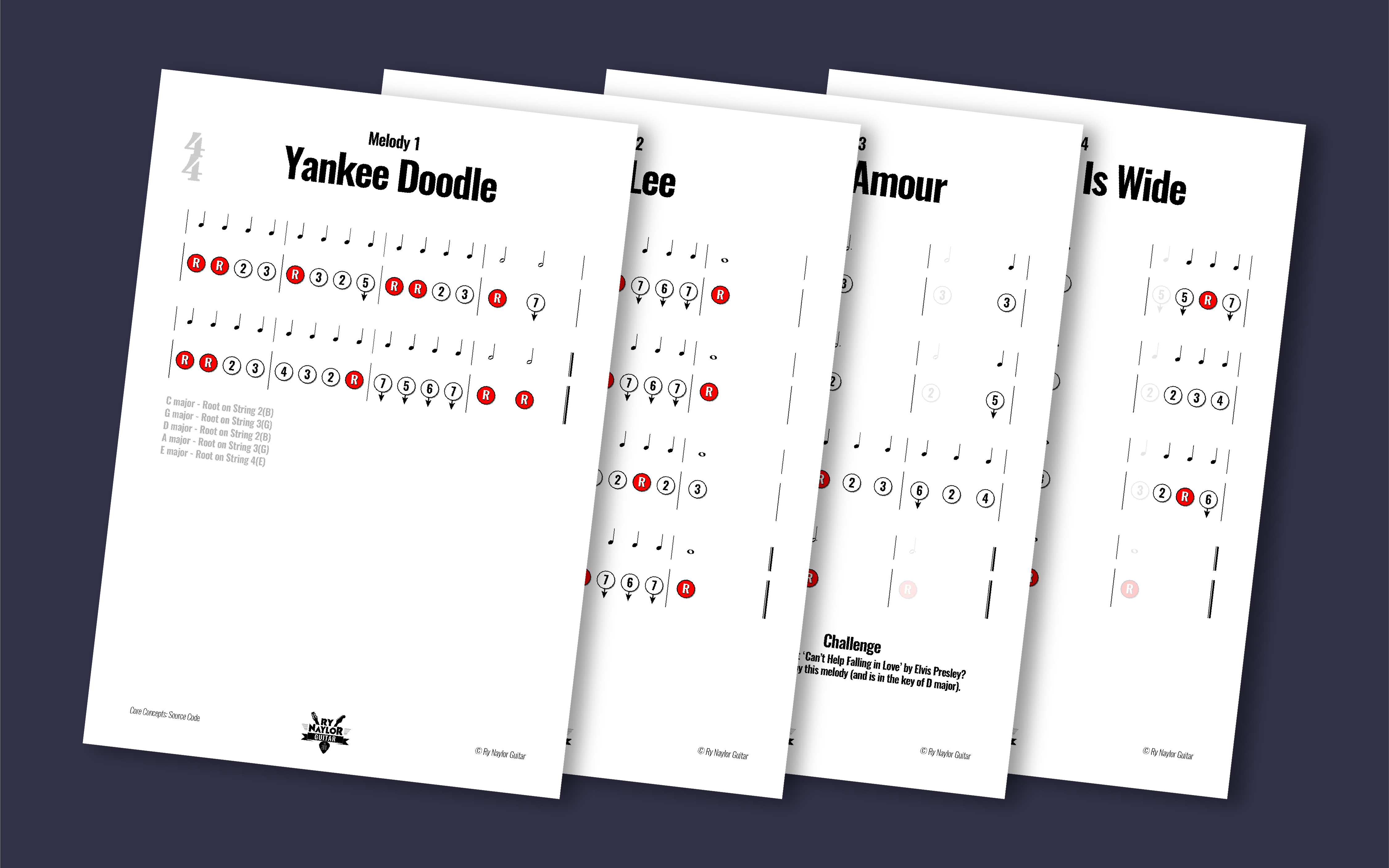
The Melody-by-Numbers Songbook is where the ideas from the course become practical.
Instead of presenting melodies as TAB or traditional notation, they're written as scale degrees.
That means the same sequence of numbers can be used in any key.
Throughout the course, I'll guide you through selected melodies, showing you how to find the notes, understand their relationships and move the music into different keys.
Then it's your turn.
The remaining melodies give you an opportunity to explore the system independently, at your own pace.
And that's really the goal of Source Code.
Not simply to follow my instructions, but to understand the music well enough that you can work things out for yourself.

“I think the biggest value of Source Code is the emphasis it places on playing and transcribing melodies using the number system.
This is great for connecting the sounds of the song to both my ears AND through the fingers on the fretboard."
Who's this course for?
Is Source Code right for you?
Source Code is designed for late-beginner and intermediate guitarists who want to develop a clearer understanding of the music they're playing.
It's a good fit if...
- You've learned some scales and chords but aren't always sure how everything connects.
- You can play scale patterns but struggle to use them to make music.
- You want to understand the relationships between notes and keys.
- You're interested in improving your ear and learning melodies more independently.
- You enjoy a structured, methodical approach to learning guitar.
It might not be what you're looking for if...
- You're primarily interested in collecting new licks or learning songs note for note.
- You're already completely comfortable playing melodies in different keys using scale degrees.
You don't need an advanced knowledge of music theory, and you don't need to own any of my other courses.
Just bring your guitar, a little curiosity, and a willingness to practise.
Where Source Code fits
Part of the Core Concepts learning path
Source Code is the second course in my Core Concepts series, designed to give guitarists a clear foundation in the musical ideas that everything else builds upon.
Fretboard GPS teaches you to find the notes.
Source Code teaches you to understand the scales those notes belong to, and how to use them to play music.
From there, we'll continue exploring harmony, chords, rhythm and the rest of the fretboard.
Fretboard GPS is the recommended starting point, but it's not a prerequisite. Source Code works perfectly well as a standalone course.

Charles Kutler (New York)
“Ry’s visually stunning course, Source Code, is unlike anything else available: this guitar learning program transforms melodic scales from patterns to memorize into possibilities to explore.
We don’t just learn scales. Ry helped me unlock the music inside them. I discovered how notes connect, how melodies take shape, and how to make it my own.
Every step is thoughtfully designed to guide us with care, purpose, and clarity so we can move beyond practicing scales and start playing with intention, confidence, and expression. I love it!”

Harold Barnes (North Carolina)
“Ry's Source Code course breaks down the fretboard in a way that actually makes sense.
It takes the guesswork out of guitar theory and gives you real, practical tools you can use right away.
If you want to connect the dots across the neck without getting bogged down in fluff, this is the course to get.”
Tom Haas (Florida)
“Like many new guitarists, I started by memorizing a dozen or so open position chords and soon I was strumming Brown Eyed Girl. I was hooked.
But moving forward was hard.
Method books, chord charts, online tutorials, You Tube videos - an endless supply of rabbit holes to climb into.
I settled on Ry’s weekly emails that started to tie things together.
I took on his Source Code class as my first ever structured course.
I only wish that I had started my guitar journey with Source Code.
It uses the open position as a foundation to understand the notes and scale degrees in all the basic keys and how music actually works.
His 'workout' routine helped me improve single note picking speed while learning and playing real melodies.
Now I’m able to improvise my own.
I highly recommend Source Code”
Nat Rose (Australia)
"Source Code with Ry Naylor has been a fantastic learning experience for me.
I have learnt to play songs in different keys, and I loved challenging myself to work out the notes of the songs in the course material.
Being able to learn scales and the scale degrees as a 'code' has opened up a whole new way of learning songs for me.
Everything is in the open position initially and then learning to transition the scales and play chords and songs in different positions on the fretboard made me realise that Source Code had really improved my guitar playing.
One lesson that I keep going back to is 'The Gravity of Music'. This has been great for tuning my ear and I have been continually using this when I start on a different key."
Jeremy Gottwals (Spain)
“I think the biggest value of Source Code is the emphasis it places on playing and transcribing melodies using the number system.
Apart from filling in some of the gaps in my fretboard knowledge in the open position, the course also pushed me to use my ears to identify musical intervals.
This is great for connecting the sounds of the song to both my ears AND through the fingers on the fretboard.
Once you have the melody down using the number system you can easily play the melodies in any key. I will continue to use this course for months and months to come.”

Bill Creighton (California)
“Once again, Ry seems to have his finger on the pulse of teaching guitar. I very much appreciate the opportunity to learn directly from him and that he continues to make himself so easily accessible.
Ry’s latest course, Source Code, has provided an incredibly improved base for my learning both theoretically and aurally.
I could not have anticipated that this change of perspective, from notes to numbers, would help me to so much more effectively understand and organize my learning.”
A note from Ry
Why I built this...
"I've been teaching guitar since 2010, and the same thing comes up again and again. Players who've put in the hours, learned their shapes, and can get around the neck, but who feel like they're guessing. They can play, but they can't tell you why what they're playing works.
I was that player once. The thing that changed it for me wasn't another scale shape or another song. It was understanding the major scale properly, as numbers, as relationships, so that the fretboard stopped being a map I had to memorize and started being something I understood.
That's the whole reason Source Code exists. Not to give you more to remember, but to give you less, by teaching you the one foundation that makes everything else fall into place. Learn this, and you've got something you'll build on for the rest of your playing life.
I hope it does for you what it did for me." 🙏🏻

Guarantee
Try Source Code for 30 days
I want you to have the opportunity to work through the lessons and see how the method fits into your playing.
Spend some time exploring the scales, playing the melodies and putting the ideas into practice.
If you don't feel the course has delivered what I've promised, just email me within 30 days of purchase and I'll refund you in full.
No awkward questions.
I'd much rather you feel confident about your purchase than be left with a course that wasn't right for you.

Black Friday Week
Just getting started? Get the complete foundation.
If you're new to my Core Concepts series, I've put together a special Starter Bundle for Black Friday week.
It brings together three resources that build on one another:
1. Fretboard GPS ($49)
Learn to find any note on the guitar using octave shapes and reliable reference points.
2. Source Code ($69)
Understand the major scale, play melodies in five keys and start putting your fretboard knowledge to use.
3. The Guitarist's Guide to the Circle of Fifths ($22)
Understand how keys, chords and scales connect, and why these relationships matter.
Together, they give you a structured path from finding the notes to understanding the music they create.
Three resources.
Normally $140.
Black Friday Bundle: $99
Save $41 when you buy them together.
Source Code isn't included in the 30% storewide Black Friday discount, so the bundle is even better value than purchasing all three products individually during the sale.
Get the Core Concepts Starter Bundle for $99
Prefer to start with Source Code on its own? You can still enrol for $69.
Already own Fretboard GPS or the Circle of Fifths guide? Check your email for a special offer that takes your existing purchases into account.
Exclusively for Black Friday week
The Course
Check out the PREVIEW lessons...
- 2.1 C Major on a Single String (String 5(A)) (1:41)
- 2.2 Mapping the Open Position Scale (around the C Chord) (3:23)
- 2.3 The C Major Pentatonic Scale (1:26)
- 2.4 The Source Code Practice System (4:30)
- 2.5 C Major Workout (playthrough) (5:48)
- 2.5.1 Useful Features of Guitar Pro 8 (9:53)
- 2.6 Melody by Numbers - Melody 1 in C Major (Yankee Doodle) (6:12)
- 2.7 Ear Training - Melodies in the Key of C
- 2.8 Before Moving On...
- 3.1 The One-Note Pivot (2:21)
- 3.2 G Major on a Single String (1:38)
- 3.3 Mapping the Open Position Scale (around the G Chord) (3:44)
- 3.4 The G Major Pentatonic Scale (1:25)
- 3.5 G Major Workout (playthrough) (6:04)
- 3.6 Melody by Numbers - Melody 2 in G Major (Aura Lee) (5:55)
- 3.7 Ear Training - Melodies in the Key of G
- 3.8 Before You Continue...
- 4.1 One Note Changes...G major becomes D major (1:22)
- 4.2 D Major on a Single String (1:22)
- 4.3 Mapping the Open Position Scale (around the D Chord) (3:32)
- 4.4 The D Major Pentatonic Scale (2:25)
- 4.5 D Major Workout (playthrough) (5:58)
- 4.6 Melody by Numbers - Melody 3 in D Major (Plaisir D'Amour) (5:56)
- 4.7 Ear Training - Melodies in the Key of D
- 4.8 A Quick Check
- 5A.1 One Note Changes...D major becomes A major (1:35)
- 5A.2 A Major on a Single String (1:00)
- 5A.3 Mapping the Open Position Scale (around the A Chord) (1:52)
- 5A.4 The A Major Pentatonic Scale (2:30)
- 5A.5 A Major Workout (playthrough) (5:46)
- 5A.6 Melody by Numbers - Melody 4 in A Major (The Water Is Wide) (6:15)
- 5A.7 Ear Training - Melodies in the Key of A
- 5B.1 - The Parallel Minor: A Major meets A Minor (2:36)
- 5B1.1 The Sound of the Natural Minor Scale (3:07)
- 5B.2 - The 'Relative' Minor (2:12)
- 5B.3 Mapping the Open Position Minor Scale (from the major scale) (4:44)
- 5B.4 - The Minor Pentatonic Scale (3:31)
- 5B.5 The Minor Scale Workout (2:05)
- 5B.5.1 A Minor Workout (Playthrough) (5:46)
- 5B.6 - Melody by Numbers - Melody 5 in A Minor (Wayfaring Stranger) (4:06)
- 5B.7 Ear Training - Melodies in the Key of Am
- 6.1 One Note Changes...A major becomes E major (1:59)
- 6.2 E Major on a Single String (1:28)
- 6.3 Mapping the Open Position Scale (around the E Chord) (3:24)
- 6.4 The E Major Pentatonic Scale (3:04)
- 6.5 E Major Workout (playthrough) (6:05)
- 6.6 Melody by Numbers - Melody 6 in E Major (Shenandoah) (4:21)
- 6.7 Ear Training - Melodies in the Key of E
- 9.1 Introduction (2:19)
- 9.2 E Natural Minor and E Minor Pentatonic (3:40)
- 9.3 E Minor Workout (5:47)
- 9.4 D Natural Minor and D Minor Pentatonic (2:19)
- 9.5 D Minor Workout (5:38)
- 9.6 G Natural Minor and G Minor Pentatonic (2:55)
- 9.7 G Minor Workout (5:21)
- 9.8 C Natural Minor and C Minor Pentatonic (3:08)
- 9.9 C Minor Workout (5:21)
Frequently Asked Questions
Do I need Fretboard GPS first?
It's the recommended starting point, since it teaches where the notes are. But Source Code explains everything it needs as it goes, so you can take it on its own.
I already know my scales. Is this too basic?
If you can play scale shapes but couldn't explain what's inside them, or transpose a melody into a new key on the spot, this is exactly the gap it fills. It's not about new shapes. It's about understanding.
What do I need?
Your guitar, and ideally a metronome. Everything else, the manual, songbook and audio, is included.
How long does it take?
Work at your own pace. Each key is a self-contained unit, so you can take one a week or move at whatever pace suits your level.
Is this for acoustic or electric?
Either. The method is about understanding the fretboard, which is the same on both.
Will there be more courses?
Yes. Source Code is part of the Core Concepts foundation, with more on the way. Own this and you're set up for everything that follows.
Do I need Guitar Pro 8?
All the scale workouts in this course are notated in Guitar Pro 8. I've included a playthrough of each workout at 100 BPM, and each workout has downloadable TAB in PDF and Guitar Pro format (.gp and .gpx).
Owning Guitar Pro 8 offers a lot more flexibility in your practice. You can slow a workout down while it's new, loop sections you want to drill, and build the tempo up over time.
There's a 20% discount on Guitar Pro 8 for all Source Code students.
The transformation
Where you are now. Where you'll be.
Before
- You know the shapes, but aren't always sure what you're playing.
- One key, maybe two... and only the ones your songs happen to be in.
- "Transposing" means reaching for a capo.
- Key signatures are trivia you've read about and never used.
- The Circle of Fifths is a poster. A nice one. Still a poster.
- Practice is whatever you fancy that day.
- Your ear can't tell a 3 from a 4 - they're just dots in a box.
- Playing by ear is something other people do.
After
- You play numbers, and the notes take care of themselves.
- Five keys in the open position — C, G, D, A and E, cold.
- Any melody in the songbook, in any of the five keys, on request.
- You know why E major has a D# and not an Eb...and you can explain it.
- You've built five segments of the Circle by playing them, not memorising them.
- A defined metronome routine you can run on any scale, for the rest of your life.
- You hear the difference between a 3 and a 4 and you know which one wants to move.
- You're ready for what comes next up the neck, with the foundation actually under you.
Final invitation
Ready to make more sense of your guitar?
You don't need to memorise endless patterns to become a more knowledgeable guitarist.
Sometimes, understanding a few fundamental ideas properly is far more valuable.
That's what Source Code is about.
Learning how the major scale works, hearing the relationships between notes, and putting that knowledge into practice through real melodies.
I'll guide you through it one key at a time.
Get lifetime access to Source Code for $69.
30-day money-back guarantee.
